Spiritual Heart of Portuguese Goa
Sightseeing
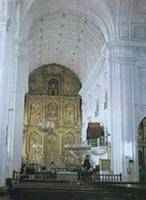 Se Cathedral
Se CathedralThe largest Churches in Old Goa, Se Cathedral was begun in 1562 during the reign of King Dom Sebastiao (1557-8). It was substantially completed by 1619, though the altars were not finished until 1652. The cathedral was built for the Dominicans and paid for by royal treasury out of the proceeds of the sale of crown property.
The building's style is Portuguese-Gothic with a Tuscan exterior and Corinthian interior. They were once two tower a, one either side of the facade, but one collapsed in 1776 The remaining tower houses a famous bell, one of the largest in Goa, often called Golden Bell because its rich sound. The main altar is dedicated to St Catherine of Alexandra, and painting on either side of it depict scenes from life and martydom.
Convent & Church of St Francis of Assisi
This is one of the most interesting building in Old Goa. It contain gilded and carved woodwork, old murals depicting scenes from the life of St Francis, and a floor substantially made of carved gravestones-complete with family coats of arms dating back to the early 16th century. The church was built by eight Franciscan friars who arrives here in 1517 and constructed a small chapel consisting of three altars and a choir. This was later pulled down and the present building was built on the same spot in 1661.
The convent at the back of this church is now the Archaeological Museum (open Saturday to Thursday, 10 am to 5 pm; free entry). It is home to many portraits of the Portuguese viceroys, most of them inexpertly touched up or restored; fragments of sculpture from Chalukyan and Hoysala influences; stone Vetal images from the animist cult which flourished in this part of India Centuries ago; and model of a Portuguese carvel, minus the rigging.
Church of St Cajetan
 Modeled on the original design of St Peter's in Rome, this church was built by Italian friars of the Order of Theatines, who were sent by Pope Urban III to preach Christianity in the kingdom of Golconda ( near Hyderabad ). The friars were not permitted to work in Golconda, so settled at Old Goa in 1640. The construction of the church began in 1655. Historically, It's of much less interest than the other churches.
Church of St Augustine Ruins
All that is really left of this church is the enormous 46 meters tower which served as a belfry and formed part of the facade of the church. The few other remnants are choked with creepers and weeds, and access is difficult. The church was constructed in 1602 by Augustine friars who arrived at Old Goa in 1587. It was abandoned in 1835 due to the repressive policies of the Portuguese government, which was resulted in the eviction of many religious orders from Goa. The church fell into neglect and the vault collapsed in 1842. In 1931, the facade and half the tower fell down, followed by more sections in 1938.
Convent & Church of St Monica
This huge three storey laterite building was completed in 1627, only to burn down nine years later. Reconstruction started the following year, and its from this time that the building date. Once known as the Royal Monastery, due to the royal patronage which it enjoyed, the building is now used by the Master Dei Institute as a nunnery and was inaugurated in 1964. Visitors are allowed inside if they are reasonably dressed. There are fading murals on the inside of the western walls.
The Basilica of Bom Jesus(1594)
 Basilica of Bom JesusThe world-renowned church contains the body of St. Francis Xavier, a former pupil of soldier - turned - saint, Ignatius Loyola, the founder of the Order of Jesuits. St. Francis Xavier remains the principal spiritual treasure of the territory. The Jesuits began work on their own church in 1594. By 1605 it was finished and consecrated. In 1613 the body of St. Francis was brought there from the Clooege of ST Paul. It was moved into the church in 1624 and its present chapel in 1655 where it has remained ever since. St. Francis was canonized by Pope Gregory XV in 1622 and in 1624 and 1964 Pope XII raised the church to minor basilica. The Order of Jesuits was suppressed in 1759 and its property confiscated by the State. The church was, however allowed to continue services. The Professed House, next door to the basilica, is a two storey laterite building covered with lime plaster. It was completed in 1585, despite much opposition to the Jesuits. Part of the building burned down in 1633 and was partially rebuilt in 1783. There's a modern art gallery attached to basilica.
|
|
|
| Incredible india |
| » | |
| » | |
| » | |
| » | |
| » | |
| » | |
| » | |
|
| |
| India package tours |
| » | |
| » | |
| » | |
| » | |
| » | |
| » | |
| » | |
| » | |
| » | |
| » | |
|
| |
|
|