|
Khajuraho
|
| |
|
Sightseeing |
| |
|
Parsvanath |
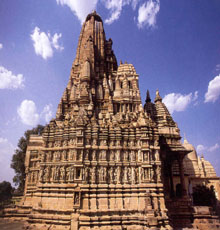 The largest of the Jain temples in the walled enclosure is also one of the finest at Khajuraho. Although it does not approach the western enclosure
temples in size, and does not attempt to compete in the sexual activity stakes, it is notable for the exceptional skill and precision of its construction, and for the beauty of its sculptures. Some of the best known figures at Khajuraho can be seen here, including the classic figure of a woman removing a thorn from her foot and another of a woman applying eye make-up. Although it was originally dedicated to Adinath, an image of Parsvanath was substituted about a century ago; the temple takes its name from this newer image. The largest of the Jain temples in the walled enclosure is also one of the finest at Khajuraho. Although it does not approach the western enclosure
temples in size, and does not attempt to compete in the sexual activity stakes, it is notable for the exceptional skill and precision of its construction, and for the beauty of its sculptures. Some of the best known figures at Khajuraho can be seen here, including the classic figure of a woman removing a thorn from her foot and another of a woman applying eye make-up. Although it was originally dedicated to Adinath, an image of Parsvanath was substituted about a century ago; the temple takes its name from this newer image. |
| |
|
Adinath |
 Adjacent to the Parsavnath Temple, the smaller Adinath has been partially restored over the centuries. It has fine carvings on its three bands of sculptures and, like the Parsavnath, is very similar to the Hindu temples of Khajuraho. Only the striking black image in the inner section indicates that it is Jain rather than
Hindu. Adjacent to the Parsavnath Temple, the smaller Adinath has been partially restored over the centuries. It has fine carvings on its three bands of sculptures and, like the Parsavnath, is very similar to the Hindu temples of Khajuraho. Only the striking black image in the inner section indicates that it is Jain rather than
Hindu. |
| |
|
Javari |
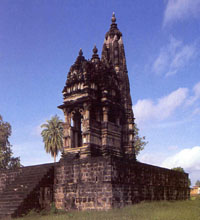 Walk through the village, a typical small Indian settlement, to this temple, Dating from to around 1075 to 1100 AD, it is dedicated to Vishnu and is particularly fine example of Khajuraho architecture on a small scale. The exterior has more of Khajuraho's maidens. Walk through the village, a typical small Indian settlement, to this temple, Dating from to around 1075 to 1100 AD, it is dedicated to Vishnu and is particularly fine example of Khajuraho architecture on a small scale. The exterior has more of Khajuraho's maidens. |
| |
|
Duladeo |
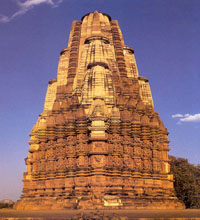 A dirt track runs to this isolated temple, about 1km south of the Jain enclosure. This is a later temple, and experts say that at this time the skill of Khajuraho's temple builders had passed its peak and the sculptures are more 'wooden' and 'stereotyped' than on earlier temples. Nevertheless, it's a fine and graceful temple with figures of women in a variety of pin-up poses and a number of mithuna couples. A dirt track runs to this isolated temple, about 1km south of the Jain enclosure. This is a later temple, and experts say that at this time the skill of Khajuraho's temple builders had passed its peak and the sculptures are more 'wooden' and 'stereotyped' than on earlier temples. Nevertheless, it's a fine and graceful temple with figures of women in a variety of pin-up poses and a number of mithuna couples. |
| |
|
Chaturbhuja |
 South of the river, about 3km from the village and a healthy hike down a dirt road, this ruined temple has a fine 3m-high image of Vishnu. South of the river, about 3km from the village and a healthy hike down a dirt road, this ruined temple has a fine 3m-high image of Vishnu. |
| |
|
Archaeological Museum |
| Close to the western enclosure, this small museum has a
fine collection of statues and sculptures rescued from around Khajuraho. |
| |
|
Shanti Nath |
| This temple is a relatively modern one built about a century ago, but it contains many components from older temples around
Khajuraho. The 4.5m-high statue of Adinath is said to have been sculpted in 1028.Groups of Digambara (Sky-clad, or naked) Jain pilgrims
occasionally stay at the dharamsala (pilgrims' lodging) here. |
| |
|
Brahma & Hanuman |
|
Turning back (west) towards the modern village, you pass a granite and sandstone temple, one of the oldest at Khajuraho. It was actually dedicated to Vishnu and the definition of it as a Brahma temple is incorrect.
Taking the road directly from the modern village to the Jain enclosure, you pass a Hanuman Temple containing a large image of the monkey god. This 2.5m statue has on it the oldest inscription here - 922 AD.
|
| |
|
Vamana |
| About 200m north of Javari Temple, this temple is dedicated to Vamana, the dwarf incarnation of Vishnu. Slightly older than the Javari Temple, the Vamana Temple stands out in a field all by itself. It's notable for the relatively simple design of its sikhara. The bands of sculpture around the temple are, as usual, very fine with numerous celestial maidens adopting interesting poses. |
| |
|
Ghantai |
| Walking from the eastern Jain temple group towards Khajuraho village, you come to this small, ruined Jain temple. Only its pillared shell remains, but it is interesting for the delicate columns with their bell-and-chain decoration and for the figure of a Jain goddess astride a Garuda that marks the entrance. |
| |
|
<--Back |


 Best Tours Packages