|
Mandu
|
| |
|
Sightseeing |
| |
|
Jahaz Mahal :- |
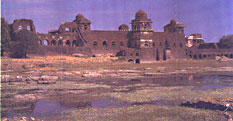 This120m long 'ship balance' built between the two
artificial lakes, Munj Talao, is an elegant Two-storeyed palace. Probably it was
built by Sultan Ghiyas-ud-din Khilji for his large harem. With its open
pavilions, balconies overhanging the water and open terrace, the
Jahaz Mahal is an imaginative recreation in stone of a royal pleasure craft. This120m long 'ship balance' built between the two
artificial lakes, Munj Talao, is an elegant Two-storeyed palace. Probably it was
built by Sultan Ghiyas-ud-din Khilji for his large harem. With its open
pavilions, balconies overhanging the water and open terrace, the
Jahaz Mahal is an imaginative recreation in stone of a royal pleasure craft. |
| |
|
Hindola Mahal :- |
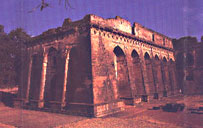 An audience hall also belonging to Ghiyas-ud-din's reign,
it drives the name of 'Swinging Place' from its sloping side walls.
Superb and innovative technique are also evident in its ornamental
facade, delicate trellis works in a sandstone and beautifully moulded columns.
To
the west of Hindola Mahal there are several unidentified buildings which
still bear traces of their past grandeur. Amdist these is an elaborately
constructed well called Champa Baoli which is connected with underground
vaulted room where arrangements for cold and hot water were made. An audience hall also belonging to Ghiyas-ud-din's reign,
it drives the name of 'Swinging Place' from its sloping side walls.
Superb and innovative technique are also evident in its ornamental
facade, delicate trellis works in a sandstone and beautifully moulded columns.
To
the west of Hindola Mahal there are several unidentified buildings which
still bear traces of their past grandeur. Amdist these is an elaborately
constructed well called Champa Baoli which is connected with underground
vaulted room where arrangements for cold and hot water were made. |
| |
|
Hoshang Sha's Tomb :- |
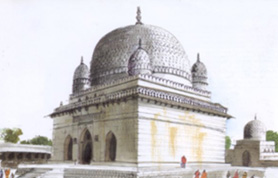 India's first marble edifice is one of the most refined
examples of Indo-Islamic architecture. Its unique features are the
magnificently proportioned dome , marble latticework of remarkable
delicacy and proticoes, court and towers to mark the four corners of the
rectangle. India's first marble edifice is one of the most refined
examples of Indo-Islamic architecture. Its unique features are the
magnificently proportioned dome , marble latticework of remarkable
delicacy and proticoes, court and towers to mark the four corners of the
rectangle. |
| |
|
Jami Masjid :- |
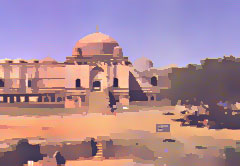 Inspired by the great mosque of Damscus, the Jami Masjid
was conceived on a grand scale , with a high plinth and a huge domed porch
projection in the centre, background dominated by similar imposing domes
with the inventing space filled up by seemingly innumerable domes. Inspired by the great mosque of Damscus, the Jami Masjid
was conceived on a grand scale , with a high plinth and a huge domed porch
projection in the centre, background dominated by similar imposing domes
with the inventing space filled up by seemingly innumerable domes. |
| |
|
Asharfi Mahal :- |
| Built by Hoshang Shah's
Khilji,
this' place of gold coin' facing the jami masjid was conceived as an
academic institution (madrassa) for young boys and study cells still remains in
a fair state of preservation. In a same complex he built seven
storeyed tower to celebrate his victory over Rana Kumba of Mewar, of which
one building survived. Also ruins is the tomb which was intended to be the
largest structure in Mandu, but which collapsed due to hasty and faulty
construction. |
| |
|
Rewa Kund :- |
A reservoir built by Baz Bahadur with an aqueduct to
provide Roopmati's p alace
with water .today the pool is revered as a sacred spot. alace
with water .today the pool is revered as a sacred spot. |
| |
|
Baz Abrader's Palace:- |
| Built in the early 6th century by Baz Bahadur, the palace's
unique features are spacious courtyard surround by halls and high terrace. |
| |
|
Roopmati's Pavilion :- |
| The pavilion was originally built as army observation post.
From its hill top perch, this graceful structure with its two pavilions was
retreat of the lovely queen, from where she could see Baz Bahadur's Palace and
Narmda from far flow |


 Best Tours Packages