|
|
|
|
|
|
|
|
|
|
|
|
|
|
|
|
|
|
|
 More About India
 |
|
|
|
|
|
|
|
| |
|
Gwalior
|
| |
|
Sightseeing |
| |
|
Sas Bahu Temple |
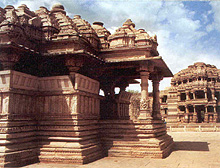 The
Sas
Bahu, or Mother-in-Law and Daughters-in-Law temples, stand close to the eastern wall about midway along that side of the fort. The two temples are similar in style, and date from the 9th to 11th centuries. Sas Baud ka Mandir is also dedicated to Lord Vishnu. Originally
known as the 'Sahasrabahu' temple, this is probably the most
ancient structure within the fort walls, built by Mahipala, the Kachchwan King, in the early 11th century AD. The larger temple has an ornately carved base and figures of Vishnu over the entrances, and four huge pillars carry the heavy roof. The
Sas
Bahu, or Mother-in-Law and Daughters-in-Law temples, stand close to the eastern wall about midway along that side of the fort. The two temples are similar in style, and date from the 9th to 11th centuries. Sas Baud ka Mandir is also dedicated to Lord Vishnu. Originally
known as the 'Sahasrabahu' temple, this is probably the most
ancient structure within the fort walls, built by Mahipala, the Kachchwan King, in the early 11th century AD. The larger temple has an ornately carved base and figures of Vishnu over the entrances, and four huge pillars carry the heavy roof.
|
| |
|
Gurudwara Data Bandhi Chhod |
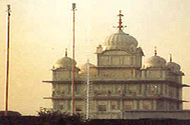 Between the Teli Ka Mandir and the Sasbahu
temples is an impressive gleaming white Sikh
gurudwara, or temple.Built in the memory of Guru Hargovind Saheb the
sixth Sikh Guru, who was imprisoned here by Emperor Jehangir for over two
years. Between the Teli Ka Mandir and the Sasbahu
temples is an impressive gleaming white Sikh
gurudwara, or temple.Built in the memory of Guru Hargovind Saheb the
sixth Sikh Guru, who was imprisoned here by Emperor Jehangir for over two
years. |
| |
|
Jai Vilas Palace & Scindia Museum |
|
 Although the current maharaja still lives in the palace of Scindia family, 35 rooms are now a museum. It's full of the bizarre items Hollywood maharajas are supposed to collect, such as Belgium cut-glass furniture (including a rocking chair), and what looks like half the tiger population of India, all shot, stuffed and moth-eaten. Modes of transport range from a Rolls Royce on rails to a German bubble car. Then there is a little room full of erotica, including a life-sized marble statue of Leda having her way with a swan. But the pièce de resistance is a model railway that carried brandy and cigars around the dining table after dinner. Although the current maharaja still lives in the palace of Scindia family, 35 rooms are now a museum. It's full of the bizarre items Hollywood maharajas are supposed to collect, such as Belgium cut-glass furniture (including a rocking chair), and what looks like half the tiger population of India, all shot, stuffed and moth-eaten. Modes of transport range from a Rolls Royce on rails to a German bubble car. Then there is a little room full of erotica, including a life-sized marble statue of Leda having her way with a swan. But the pièce de resistance is a model railway that carried brandy and cigars around the dining table after dinner.
The main durbar hall is impressive. The gold paint used around the room is said to weigh 58kg, and the two giant chandeliers are incredible; they each hold 248 candles, are 12.5m high and weigh 3.5 tonnes apiece - so heavy that before they were installed, elephants were suspended were suspended from the ceiling to check that it could take the weight.
|
| |
|
Tansen's Tomb
|
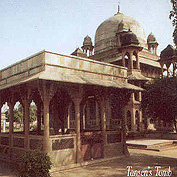 A pillar of
Hindustani classical music, the great Tansen, one of the 'nine-jewels'
of Albar's court lies buried in Gwalior. The memorial of the great
musician has a pristine simplicity about it, and is built in the early
Mughal architectural style. More than a monument, the tomb is part of
Gwalior's living cultural heritage; it is the venue of a national scale
music festival, held annually in November-December. A pillar of
Hindustani classical music, the great Tansen, one of the 'nine-jewels'
of Albar's court lies buried in Gwalior. The memorial of the great
musician has a pristine simplicity about it, and is built in the early
Mughal architectural style. More than a monument, the tomb is part of
Gwalior's living cultural heritage; it is the venue of a national scale
music festival, held annually in November-December. |
| |
|
Archaeological Museum |
| The
museum is within the Gujri Mahal. Built in the 15th century by
Man Singh for his favourite queen, Mrignayni, the palace is now in a
rather deteriorated condition. There's a large collection of Hindu and
Jain sculptures and copies of the Bagh Caves frescoes. |
| |
|
<--Back |
|


