|
|
|
|
|
|
|
|
|
|
|
|
|
|
|
|
|
|
|
 More About India
 |
|
|
|
|
|
|
|
| |
|
Jabalpur
|
| |
|
Sightseeing |
| |
|
Marble Rocks:- |
Situated 23km on the river Narmada there are the main attractions near
Jabalpur. Boating facilities are available here from November to May and
moonlight boating along the "Marble Cliffs " is thrilling
experience.
The rocks are floodlit at night for dramatic effect .However MP Tourism is heavily promoted it
and views on this tourist spot vary from 'truly spectacular' to 'a
total bust'. It really all depends on when you come. Steer clear of
the place at weekends and on the right of the full moon as it is
packed with local tourists. The best way to see the km ling gorge is
by shared rowboat. These go all day every day from the jetty at the
bottom of the gorge where the sign advertisers 'Boating without any
thinking'. The cliffs at the foot of the gorge are floodlit at night.
At
the head of the gorge is the Dhuandhar or Smoke Cascade. All around
the falls are hundreds of stalls selling marble carvings, much of it
fairly clichéd but you can find some nice prices if you shop around
and bargain hard.
Above the lower end of the gorge, a flight over 100s tones Madanpur
temple. This circular Temple has damaged images of the 64 yoginis,
or attendants of the goddess Kali. |
| |
|
Dhuandhar
Falls :- |
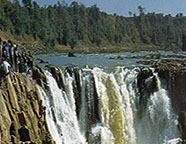 The
river Narmda after meandering its way through the "Marble Rock"
,plunges into a fall the roar of which can be heard from far. The
river Narmda after meandering its way through the "Marble Rock"
,plunges into a fall the roar of which can be heard from far. |
| |
|
Chausath
Yogini Temple :- |
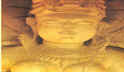 It is dedicated to Goddess Durga and was built in the 10th century. The delicately
carved statues of deities belong to the Kalchuri period. It is dedicated to Goddess Durga and was built in the 10th century. The delicately
carved statues of deities belong to the Kalchuri period. |
| |
|
Tilwara
Ghat :- |
| Situated
on the banks of Narmada, it is where the Mahatma Gandhi 's ashes were immerged
in the river. |
| |
|
Madan
Mahal Fort :- |
| It
was built by the Gond ruler, Raja Madan Shah in 1116. A top rocky hill ,
it dominates the skyline. |
| |
|
Sangram
Sagar & Bajnamath :- |
| Built
by the famous Gond King Sangram Shah between 1480-1540, these are Medieval constructions. |
| |
|
Rani
Durgavati Museum :- |
Rani
Durgavati Museum was named after the queen, the museum was founded in
1964. It is a collection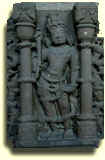 of stone sculptures and prehistoric relics. These sculptures are ichnographically
excellent and are eloquently executed. In this
collection are icons of Uma-Maheshwara (Lord Shiva and his consort Parvati),
Ganesha (Shiva and Parvati’s elephant-headed son), Uma-Maheshwara
playing Chauser (a gambling
sport), Lord Vishnu (the Preserver of the Universe), Lakshmi-Narayana
(the Goddess of Wealth with Lord Vishnu), Balrama (Lord Krishna’s
brother), Vamana (Lord Vishnu’s dwarf incarnation), Narsingh (Lord
Vishnu’s lion incarnation), Gauri (Parvati), Sarasvati (Goddess of
Knowledge) and images of Jain saints.
of stone sculptures and prehistoric relics. These sculptures are ichnographically
excellent and are eloquently executed. In this
collection are icons of Uma-Maheshwara (Lord Shiva and his consort Parvati),
Ganesha (Shiva and Parvati’s elephant-headed son), Uma-Maheshwara
playing Chauser (a gambling
sport), Lord Vishnu (the Preserver of the Universe), Lakshmi-Narayana
(the Goddess of Wealth with Lord Vishnu), Balrama (Lord Krishna’s
brother), Vamana (Lord Vishnu’s dwarf incarnation), Narsingh (Lord
Vishnu’s lion incarnation), Gauri (Parvati), Sarasvati (Goddess of
Knowledge) and images of Jain saints.
The cult of the goddess Durga (worshipped as Shakti) gained
prominence and became very popular in the Middle Ages. In the Rani
Durgavati Museum is displayed a 36cm high sandstone idol of Durga, a
specimen sculpture of Kalchuri art which was procured from Doni.
Sarasvati, the wife of Brahma (Hindu Creator of the Universe) is the
patron of art, music and letters. Attended by a swan, she is depicted as
a beautiful, fair young woman, often with a veena
(Indian lute) and a book in her hand. Traditionally, she was the
inventor of the Sanskrit language and the Devanagari script (Sanskrit
and Hindi script). A circa 10th century a.d. sandstone sculpture of Sarasvati is now on display in the Rani
Durgavati Museum.
Yoginis
are lesser divinities in the cult of Shakti, and were widely believed to
be sorceresses. This Museum has the sculpture of a seated Yogini,
portrayed with four hands with a lion at her feet. It can be safely said
that the cult of Shakti (Energy/Power) was a major source of inspiration
for the art of the Kalchuris.
A 10th century red sandstone sculpture from Tripuri
depicts the
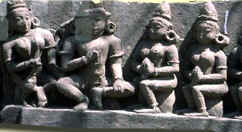 story
of a gamble between Shiva, the Hindu Destroyer of the Universe, and his
consort, Parvati. They are seated on the slopes of the Himalayan Mount
Kailasha playing Chauser, a
gambling sport. Brahma (the Hindu Creator of the Universe) and Vishnu
are shown amidst clouds with their consorts Sarasvati and Lakshmi
respectively, while Bhairava, Virabhadra, Bhringi, Ganesha, Kartikeya
and other devotees look on with great curiosity. The sculpture makes the
ultimate result of the game seem more interesting than the game itself.
Shiva is made to lose the game, and expressions of delight are visible
on the faces of Parvati and all the female attendants. story
of a gamble between Shiva, the Hindu Destroyer of the Universe, and his
consort, Parvati. They are seated on the slopes of the Himalayan Mount
Kailasha playing Chauser, a
gambling sport. Brahma (the Hindu Creator of the Universe) and Vishnu
are shown amidst clouds with their consorts Sarasvati and Lakshmi
respectively, while Bhairava, Virabhadra, Bhringi, Ganesha, Kartikeya
and other devotees look on with great curiosity. The sculpture makes the
ultimate result of the game seem more interesting than the game itself.
Shiva is made to lose the game, and expressions of delight are visible
on the faces of Parvati and all the female attendants. |
|


